
NYTimes: Orioles 4, Yankees 0
A New Low for Clemens and the Yankees
Or, as the New York Daily News put it: Money for Nothing: $28M Rocket fizzles as Yanks' skid hits four
*2057: watch the film
Schadenfreude, baby.

These cases consider the longstanding efforts of two local school boards to integrate their public schools. The school board plans before us resemble many others adopted in the last 50 years by primary and secondary schools throughout the Nation. All of those plans represent local efforts to bring about the kind of racially integrated education that Brown v. Board of Education, 347 U. S. 483 (1954), long ago promised -- efforts that this Court has repeatedly required, permitted, and encouraged local authorities to undertake. This Court has recognized that the public interests at stake in such cases are "compelling." We have approved of "narrowly tailored" plans that are no less race-conscious than the plans before us. And we have understood that the Constitution permits local communities to adopt desegregation plans even where it does not require them to do so.
The plurality pays inadequate attention to this law, to past opinions' rationales, their language, and the contexts in which they arise. As a result, it reverses course and reaches the wrong conclusion. In doing so, it distorts precedent, it misapplies the relevant constitutional principles, it announces legal rules that will obstruct efforts by state and local governments to deal effectively with the growing resegregation of public schools, it threatens to substitute for present calm a disruptive round of racerelated litigation, and it undermines Brown's promise of integrated primary and secondary education that local communities have sought to make a reality. This cannot be justified in the name of the Equal Protection Clause.
There is a cruel irony in The Chief Justice's reliance on our decision in Brown v. Board of Education, 349 U. S. 294 (1955). The first sentence in the concluding paragraph of his opinion states: "Before Brown, schoolchildren were told where they could and could not go to school based on the color of their skin." This sentence reminds me of Anatole France's observation: "[T]he majestic equality of the la[w], forbid[s] rich and poor alike to sleep under bridges, to beg in the streets, and to steal their bread." The Chief Justice fails to note that it was only black schoolchildren who were so ordered; indeed, the history books do not tell stories of white children struggling to attend black schools. In this and other ways, The Chief Justice rewrites the history of one of this Court's most important decisions....
The Court has changed significantly since it decided School Comm. of Boston in 1968. It was then more faithful to Brown and more respectful of our precedent than it is today. It is my firm conviction that no Member of the Court that I joined in 1975 would have agreed with today's decision.

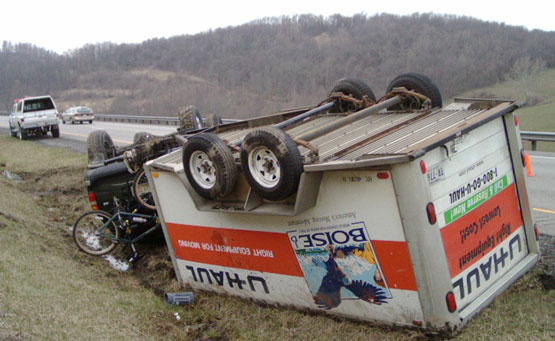
Among U-Haul's 100,000 trucks are many aging, high-mileage vehicles. Many have logged more than 100,000 miles. A recent court filing by U-Haul underscored the fleet's age: A company executive, referring only to the type of truck rented to Waldrip, said 4,595 of them were still on the road with 200,000 miles or more.
U-Haul has purchased about 38,000 new trucks over the last two years and has sold nearly as many older ones. But the company says it does not automatically retire vehicles at a fixed mileage or age.
Penske Truck Leasing, one of U-Haul's two major competitors, says that it replaces up to half its consumer rental fleet every year and that its oldest trucks are about 3 1/2 years old. Budget Truck Rental says the average age of its trucks is 2 to 2 1/2 years.
During a yearlong investigation, Times journalists surveyed more than 200 U-Haul trucks and trailers in California and other states and found that more than half were overdue for a company-mandated "safety certification," a check of brakes, tires and other parts typically required every 30 days.
Some safety checks were more than a year overdue.

The US Senate is trying to force states to adopt a National ID card: it's time to stop them. As part the debate on immigration legislation, the states will be forced to become REAL ID compliant.
States have strongly resisted this unfunded federal mandate – one that the Department of Homeland Security expects to cost more that $23 billion or almost $100 per license holder. Seventeen states have said 'no' to REAL ID – labeling it invasive, un-American, costly and an invitation to identity theft. They know it will force citizens to stand in long lines for licenses and endure numerous hassles looking for documents like birth certificates.
Now instead of listening to the states, the US Senate is trying to force them to comply through the back door. As part of immigration legislation being considered next week in the Senate, an employment verification system will be created that requires everyone to have a REAL ID in order to get a job.
There is still hope. There are two amendments that will remove REAL ID from the Senate immigration bill: take action now.
>> Click Here to Fax your Senators...

On Tuesday, SEMO pegged the damage to public property in the Delaware County town at about $5 million - far short of the number for the Federal Emergency Management Agency to step in. Now that number has climbed to "a little more than $20 million," Michalski said.
That estimate for public property only refers to roads and bridges, debris removal and the emergency response, Michalski said.
SEMO has not yet assessed the damage to 150 homes because several roads have been impassable.
The damage to personal property along the 4-mile stretch north of Roscoe also has been staggering. The latest count has 33 homes, mobile homes and other structures destroyed. Another 12 homes have had major damage, and six with minor damage.
Numerous cars and motorcycles were also flattened, or swept downstream.
About 99 percent of the damage is in Delaware County, along County Road 7 (Route 206 in Sullivan County) and town roads off Spring Brook, in an area known as Cat Hollow. A tiny amount is in the neighboring Sullivan County Town of Rockland.
COLCHESTER _ The towns of Colchester and Andes remain under states of emergency because of significant flooding June 19, according to a news release Tuesday from the Delaware County Department of Emergency Services.
County Route 7, also known as Cat Hollow Road and state Route 206, will be closed between Roscoe and Downsville for an undetermined amount of time. Many of the roads near county Route 7 have been devastated and are closed.

Delaware County 911 Coordinator and Deputy Emergency Services Director Steve Finch told MidHudsonNews.com today that early assessment of property damage just to Delaware County exceeds $5 million. That just pertains to county roads, bridges and other infrastructure that was damaged or destroyed. The raging floodwaters were so intense that they tore large slabs of pavement off roadways.

[Saturday, when the United States plays an exhibition against Brazil at Giants Stadium in East Rutherford, N.J., Lilly is expected to make her 327th international appearance, unsurpassed by any man or woman. Only Hamm, with 158 international goals, has scored more than Lilly’s 122.]
When she began, the American women ate candy bars on the road in China and stayed in a Haitian hotel with no running water. Now Lilly forges on toward her fifth World Cup with a pioneer’s spirit and demand for excellence, even as her teammates jokingly call her Grandma, if not often to her face.
[]
While Chastain got all the attention for twirling her jersey above her head like a lasso after the winning penalty kick in the 1999 Women’s World Cup, there would have been no dramatic, victorious ending against China without Lilly’s fundamental perfection.
In overtime, with 90,000 on hand at the Rose Bowl and 40 million Americans watching on television, Lilly lined up at the near post, followed the indolent trajectory of a corner kick and rebuffed a Chinese shot with her head.

Two months worth of rain, up to eight inches pounded down late Tuesday in just two hours.


WASHINGTON - Rudolph Giuliani's membership on an elite Iraq study panel came to an abrupt end last spring after he failed to show up for a single official meeting of the group, causing the panel's top Republican to give him a stark choice: either attend the meetings or quit, several sources said.
Giuliani left the Iraq Study Group last May after just two months, walking away from a chance to make up for his lack of foreign policy credentials on the top issue in the 2008 race, the Iraq war.
He cited "previous time commitments" in a letter explaining his decision to quit, and a look at his schedule suggests why - the sessions at times conflicted with Giuliani's lucrative speaking tour that garnered him $11.4 million in 14 months.
Giuliani failed to show up for a pair of two-day sessions that occurred during his tenure, the sources said - and both times, they conflicted with paid public appearances shown on his recent financial disclosure. Giuliani quit the group during his busiest stretch in 2006, when he gave 20 speeches in a single month that brought in $1.7 million.
On one day the panel gathered in Washington - May 18, 2006 - Giuliani delivered a $100,000 speech on leadership at an Atlanta business awards breakfast. Later that day, he attended a $100-a-ticket Atlanta political fundraiser for conservative ally Ralph Reed, whom Giuliani hoped would provide a major boost to his presidential campaign.
The month before, Giuliani skipped the session to give the April 12 keynote speech at an economic conference in South Korea for $200,000, his financial disclosure shows.

Title IX turns 35 this month and the bad gals have officially won. Sex quotas in sports under the anti-discrimination law are de rigeur on college campuses. And the Bush administration's failure to even challenge this perversion of the law — concocted, for the most part, by and during the Clinton administration — means that eliminating men's sports opportunities in the name of "creating" opportunities for women now has bipartisan blessing.
Apart from issuing toothless guidance on using student surveys to comply with Title IX in 2005, the Bush administration has been a crushing disappointment to supporters of endangered men's sports.

5:30 p.m. - Six people are missing and three are presumed dead after a flash flood washed away several homes and damaged bridges just north of the Sullivan County hamlet of Roscoe last night.recordonline: Photo Gallery: Flooding: Search and Rescue
Flood waters swept homes and cars away, ripped up pavement and dumped tons of mud and rocks along an 8-mile stretch of Route 206 from a mile north of Roscoe to Route 30 near the Pepacton Reservoir in the Delaware County Town of Colchester.
An elderly woman is presumed dead after an 8-foot-high wall of water away two trailer homes in Colchester. Gertrude Melvin was visiting her daughter when the storm hit. She was unable to reach a rescue rope and was killed after water swept her away, according to her family.
Melvin’s daughter, Elaine Finkle, is a 19-year employee in Sullivan County’s Office of the Aging. Finkle’s husband, George Finkle, works for New York State Electric & Gas. A trailer belonging to George’s parents, who lived next door, was also washed away. According to one of Elaine Finkle’s co-workers, the family lost their automobiles, their home and everything in it.
Also presumed dead are Fred and Marjorie Shutts, whose home was ripped off its foundation in the same area.
Paul Piatk, the Shutts’ neighbor, saw the couple standing on the porch around 7 p.m. An 8-foot wave swept their home away. Piatk said he saw state Trooper Joe Decker dive into the water, but Decker was forced to swim back to the bank.
“It was just a big, huge wave that swept everything away,” Piatk said. “The wave came down within two minutes; the garage, the car, the motorcycle, the wave just took it.”
Also, four homes were washed away by the floods. Residents of between 15 and 18 homes in Roscoe, at the Sullivan County border, were evacuated. Drivers along Route 7 had to be rescued from their cars.
Roscoe -- When Lajos and Susanna Erdos left a friend’s house in Walton in Delaware County to travel to their home to the Village of Ellenville in Ulster County Tuesday night, they had no idea what they would encounter on a road they have taken many times before.
The elderly Hungarian couple was driving on State Route 206 around 7:30 p.m. when they were met with heavy rain, then hail, then rising waters, all within minutes.
Mrs. Erdos said she told her husband to drive on the left side of the road just because it was rising so much quicker on the right, but within a few minutes, they had to pull over due to the quickly rising rush of water coming down the road. That is where they stayed for over night until being rescued early this morning.
“We sat there for 11 hours with little food or water, and the water was up to our waists,” Mrs. Erdos told MidHudsonNews.com while having a bite to eat at a Red Cross Disaster Relief Center setup at the Roscoe Middle School. “It was so terrifying. We didn’t think we were going to come out alive. We both thought that that was it for the both us.”
The two, both in their 80s, were rescued Wednesday morning and taken to the disaster relief center, where they said they would stay until Mrs. Erdos’ daughter who lives locally would pick them up and take them home to Ellenville.


Roads closed include Morton Hill, Jug Tavern, Campbell Mountain, Holiday Brook, Berry Brook and Beaver Hill roads, Route 7 from Downsville to Roscoe, and State Route 30 in the area.



The unnatural "forcing" of the climate as a result of man-made emissions of carbon dioxide and other greenhouse gases threatens to generate a "flip" in the climate that could "spark a cataclysm" in the massive ice sheets of Antarctica and Greenland, the scientists write.
Dramatic flips in the climate have occurred in the past but none has happened since the development of complex human societies and civilisation, which are unlikely to survive the same sort of environmental changes if they occurred now.
"Civilisation developed, and constructed extensive infrastructure, during a period of unusual climate stability, the Holocene, now almost 12,000 years in duration. That period is about to end," the scientists warn. Humanity cannot afford to burn the Earth's remaining underground reserves of fossil fuel. "To do so would guarantee dramatic climate change, yielding a different planet from the one on which civilisation developed and for which extensive physical infrastructure has been built," they say.
Dr Hansen said we have about 10 years to put into effect the draconian measures needed to curb CO2 emissions quickly enough to avert a dangerous rise in global temperature. Otherwise, the extra heat could trigger the rapid melting of polar ice sheets, made far worse by the "albedo flip" - when the sunlight reflected by white ice is suddenly absorbed as ice melts to become the dark surface of open water.
The glaciers and ice sheets of Greenland in the northern hemisphere, and the western Antarctic ice sheet in the south, both show signs of the rapid changes predicted with rising temperatures."
The Arctic spring is coming two weeks ahead of time compared to a decade ago, with birds, butterflies, flowers and small animals all appearing earlier in the year as a result of climate change.
A study of a range of animals and plants living in the high Arctic has revealed that many of them are responding to the earlier spring by flowering or laying their eggs significantly ahead of their normal times of the year.
On average, the breeding and flowering seasons in the Arctic have shifted by 14.5 days but some species of mosquitoes have begun laying their eggs 30 days earlier than in the mid 1990s, Toke Hoye, of the University of Copenhagen in Denmark, said.
"Our study confirms what many people already think, that the seasons are changing and it is not just one or two warm years but a trend seen over a decade," Dr Hoye said. "This is the most extensive study of its kind in the Arctic in terms of the number and variety of species and the replication of the observations."

However, epidemiological and statistical studies definitively linking the emissions to illness are lacking.
Since 1994, the St. Louis-based Doe Run has been part of the Renco Group, the private holding company of New York businessman Ira Rennert. Rennert has earned a dubious reputation over his nearly 20 years in the mining business. His magnesium production company in Utah filed for bankruptcy in 2001, shortly after federal officials accused it of illegally disposing of hazardous waste. Another Rennert company, a steel producer in Ohio, paid millions of dollars in environmental penalties even as Rennert paid himself more than $200 million in dividends.
"He has gotten rich off junk bonds issued by metals companies he acquired, paid fines to clean up when he’s had to, stopped interest payments on bonds and bought back assets at pennies on the dollar," a 2002 Forbes magazine story said of Rennert, who owns a 100,000-square-foot home in the Hamptons. "He has done it all within the law--and within plain view of investors."


It's simple. Buy a sippy cup. Leave it in its packaging so it is totally harmless and beyond suspicion. Every time you take a commercial flight, carry the cup through security and on to the plane. That's it.

Kim Yong-chul, a 58-year-old fisherman from Taean, South Chungcheong Province, dreamed of swimming before going to work on May 18, which is believed to bring luck. To catch webfoot octopus, which like to hide in shells, he had scattered hundreds of spiny turban shell bait on the shore the day before. When he pulled in the bait, he found some pottery pieces stuck to the suckers of webfoot octopus. One animal was attached to a plate dating to the Koryo period.
Kim reported the find to authorities, and the National Maritime Museum conducted an urgent excavation. Around the spot where the octopus was caught, they found 30 pieces of 12th century Koryo pottery with chrysanthemum or vine patterns. “It seems that a ship carrying Koryo pottery in 12th century was wrecked there,” a spokesman with National Maritime Museum said on Monday. “The unearthed pottery is not of the highest quality made for royals, but it nonetheless shows the beauty of Koryo pottery.” The museum plans to start a full excavation at the beginning of July and assumes that the wreck will be found nearby.

Taguba, watching the hearings, was appalled. He believed that Rumsfeld’s testimony was simply not true. “The photographs were available to him—if he wanted to see them,” Taguba said. Rumsfeld’s lack of knowledge was hard to credit. Taguba later wondered if perhaps Cambone had the photographs and kept them from Rumsfeld because he was reluctant to give his notoriously difficult boss bad news. But Taguba also recalled thinking, “Rumsfeld is very perceptive and has a mind like a steel trap. There’s no way he’s suffering from C.R.S.—Can’t Remember Shit. He’s trying to acquit himself, and a lot of people are lying to protect themselves.” It distressed Taguba that Rumsfeld was accompanied in his Senate and House appearances by senior military officers who concurred with his denials.
“The whole idea that Rumsfeld projects—‘We’re here to protect the nation from terrorism’—is an oxymoron,” Taguba said. “He and his aides have abused their offices and have no idea of the values and high standards that are expected of them. And they’ve dragged a lot of officers with them.”

First they came for the Socialists, and I didn’t speak up,
because I wasn’t a Socialist.
Then they came for the Trade Unionists, and I didn’t speak up,
because I wasn’t a Trade Unionist.
Then they came for the Jews, and I didn’t speak up,
because I wasn't a Jew.
Then they came for me, and there was no one left
to speak up for me.
For the study, researchers looked at bird populations of more than half a million, which covered a wide range. They compared databases for 550 species from two bird surveys - the Audubon's Christmas bird count and the U.S. Geological Survey's breeding bird survey in June. The numbers of 20 different birds were at least half what they were in 1967.
Today there are 432 million fewer of these bird species, including the northern pintail, greater scaup, boreal chickadee, common tern, loggerhead shrike, field sparrow, grasshopper sparrow, snow bunting, black-throated sparrow, lark sparrow, common grackle, American bittern, horned lark, little blue heron and ruffed grouse.
The northern bobwhite and its familiar wake-up whistle once seemed to be everywhere in the East. Last Christmas, volunteer bird counters could find only three of them and only 18 Eastern meadowlarks in Massachusetts.
The bobwhite had the biggest drop among common birds. In 1967, there were 31 million of this distinctive plump bird. Now they number closer to 5.5 million.
In Massachusetts, several birds seen regularly three or four decades ago, including the Northern bobwhite and the Eastern meadowlark, have all but disappeared, according to the study.
In Michigan, the number of northern bobwhites has dropped 97% since 1966, and purple martin numbers have dropped 95% over the same period. There are also far fewer red-headed woodpeckers, eastern meadowlarks and eastern kingbirds, said Caleb Putnam, a coordinator for the Audubon Society in Grand Rapids.
New Mexico: Santa Fe New Mexican: Aububon: N.M. bird species threatened
The state's lingering drought appears to be a major factor behind the declines of all five birds on the Montana list, said Steve Hoffman, executive director of Montana Audubon.
"There is strong belief that much of the drought may be due to global warming," he said. "We should all take steps to reduce that. It's going to affect all wildlife and our own quality of life."
In New Mexico, the list includes the mountain chickadee (down 83 percent), the horned lark, (81 percent), the loggerhead shrike (74 percent), the Western meadowlark (57 percent) and the pinyon jay (54 percent).
In Ohio, the five common birds showing the greatest population declines are:
Green heron
Red-headed woodpecker
Eastern meadowlark
Northern flicker
Yellow-breasted chat
"These are not rare or exotic birds we're talking about," said Jerry Tinianow, executive director of Audubon Ohio. "They're birds that visit our feeders or congregate at nearby lakes and seashores and yet they are disappearing day by day."
In South Carolina, the society listed six species whose populations have dropped. They include the eastern meadowlark, northern bobwhite, little blue heron, red-winged blackbir, field sparrow and loggerhead shrike.
The steel barge, a former icebreaker named Arctic Challenger, has become a precarious artificial nesting site for an estimated 350 Caspian terns — slim, gull-like seabirds protected by the federal Migratory Bird Treaty Act.
[]
"The fact that these birds have settled on this barge underlines a critical problem: We need more natural habitat for them," said Susan Kaveggia, a biologist with the International Bird Rescue Research Center in San Pedro. "Terns need flat, barren, sandy or pebbly land on which to nest. There's none left in the port complex, so they're moving in desperation from boat to boat to boat."
A year ago, more than 400 Caspian and elegant terns — most too young to fly — plummeted off two privately owned barges anchored not far from the Arctic Challenger. A few hours later, local beaches were littered with baby tern carcasses.







It’s always risky to drop in unannounced on a new family.
Pushing the envelope is when about 25 people converge on a small submarine-shaped island to view the only offspring of the first pair of eagles to have successfully nested at Wachusett Reservoir. Wednesday was the coming out party for the 4-week-plus-old eaglet who was removed from its nest and fitted with two metal leg bands that give it unique identifiers that will help track it the rest of its life.
The adult eagles took the whole affair in stride. They circled the island from time to time, but kept a distant and silent vigil. Left to deal with the humans on his own, junior proved to be a really good sport. For those of us on the island, there was more than a little drama, a dose of education and a rare chance to share a moment of pride with the state agency personnel that have helped restore the bald eagle population in Massachusetts.
Resembling a mini beaver hut, the eagle’s nest was cradled near the end of a bend formed by new growth at the top of a 60-foot white pine tree. The whole configuration leaned into the 15-mile-an-hour northeast blow churning up the reservoir on Wednesday morning.


Supporters of stem cell research refuse to give up on getting their legislation signed into law this year.
As President Bush prepares to veto the measure Congress sent him last week, Sen. Tom Harkin (D-Iowa) is planning to attach the pro-research legislation to the spending bill being crafted by his Appropriations labor subcommittee.
That raises the stakes on the so-called “Labor-H” spending bill. House Appropriations Chairman Dave Obey (D-Wis.) has been trying to build a veto-proof majority for the bill, adding sweeteners to the bill such as an increase in abstinence-only education.
Bush already has threatened to veto spending bills that exceed his spending thresholds. Including legislation that repeals Bush’s 2001 stem cell research compromise could give him further incentive to nix the bill.

MARSHALL, C.J. Marriage is a vital social institution. The exclusive commitment of two individuals to each other nurtures love and mutual support; it brings stability to our society. For those who choose to marry, and for their children, marriage provides an abundance of legal, financial, and social benefits. In return it imposes weighty legal, financial, and social obligations. The question before us is whether, consistent with the Massachusetts Constitution, the Commonwealth may deny the protections, benefits, and obligations conferred by civil marriage to two individuals of the same sex who wish to marry. We conclude that it may not. The Massachusetts Constitution affirms the dignity and equality of all individuals. It forbids the creation of second-class citizens. In reaching our conclusion we have given full deference to the arguments made by the Commonwealth. But it has failed to identify any constitutionally adequate reason for denying civil marriage to same-sex couples.



 Posts
All Comments
Posts
All Comments


