
Who is this joker, why is he on Jon Stewart tonight, and how can I take seriously anyone who sounds like he inhaled helium before he speaks?
Oh.
Ewww. Conservatives are gross.

Call it global warming or don't. But most people can agree that all this extreme weather can be a costly proposition. Just last year the world incurred more than $200 billion in economic losses as a result of weather-related natural disasters.
That makes 2005 the costliest year on record, according to the Munich Re Foundation. That's the same figure U.S. Public Interest Research Group reported that the United States spent resolving weather-related incidents throughout the whole decade of the 1990s.
Drought, Wildfires and Tornadoes Swept Nation
— - This past April was the hottest ever in the United States, according to records going back to 1895, said the National Climatic Data Center in Asheville, N.C.
The hottest states were Texas and Oklahoma, which had their warmest April on record, while New Mexico, Kansas, Arkansas, Missouri and Tennessee recorded their second warmest. Twelve other states recorded one of their top-five warmest Aprils on record.
The intensely warm spring weather helped intensify thunderstorms that spawned hundreds of tornadoes across the Midwest, killing at least 10 people.
It also exacerbated drought conditions, which affected 31 percent of the contiguous United States, an increase of 5 percent from March. There were numerous wildfires, especially in the Southeast.
The good news: The record warm temperature led to below-normal residential energy demand across the country, as measured by the nation's Residential Energy Demand Temperature Index.

"Why don't you put the National Guard on the border to back up the border patrol and stop the bleeding, and then start to increase the Border Patrol, the high-tech and all of that?" O’Reilly asked. . . .
"Well, the National Guard is really, first of all, not trained for that mission," Chertoff told O'Reilly. "I mean, the fact of the matter is the border is a special place. There are special challenges that are faced there."
Chertoff added that that it would take a huge amount of National Guard troops, that they would need new training. But couldn’t the National Guard pull it off, O'Reilly asked?
"I think it would be a horribly over-expensive and very difficult way to manage this problem," Chertoff said. "Unless you would be prepared to leave those people in the National Guard day and night for month after month after month, you would eventually have to come to grips with the challenge in a more comprehensive way."

SARATOGA SPRINGS, N.Y. — Only a few years ago, John E. Sweeney was a rising star in New York Republican circles, a streetwise political operative who helped engineer the 1994 victory of a little-known state senator, George E. Pataki, over Gov. Mario M. Cuomo before going on to take a seat in Congress. There, his combative brand of politics made him a favorite of national Republican leaders, including President Bush.
But these days, with Congressional elections just six months away, Mr. Sweeney finds himself in the political battle of his life, as he faces his first significant electoral challenge since taking office in 1998, from a political novice who has not only turned out to be a surprisingly strong campaigner and fund-raiser but who also has assembled a seasoned campaign team closely tied to the vaunted Clinton operation.
The threat that independent analysts say Mr. Sweeney faces is one of the more intriguing and unexpected developments of this electoral season, since the congressman represents the solidly Republican 20th Congressional District and has emerged in recent years as one of the more prominent politicians in the state. Well liked even among his Democratic colleagues, the gregarious Mr. Sweeney has long been considered a potential candidate for higher office.
But now he finds himself battered by headlines about his own actions, including his recent attendance at a college fraternity party. He also faces the woes afflicting other Republicans around the country, who — as members of the party controlling the White House and Congress — are potentially vulnerable at a time when polls indicate that Americans are in a dark mood about the future of the nation.
[]
By most measures, Ms. Gillibrand has run an aggressive campaign that seems to have caught Mr. Sweeney off guard as it has swiftly moved to put him on the defensive.
In January, her campaign surrogates seized on reports that he organized a $2,000-a-person "Skiing with Sweeney" weekend getaway attended by lobbyists at a resort in Park City, Utah, as well as a dinner at the home of a wealthy pharmaceutical industry lobbyist.

Bush campaigned in 2004 on a pledge to hire 2,000 new Border Patrol agents each year for five years. But his '06 budget scrapped those plans and asked for only 210.
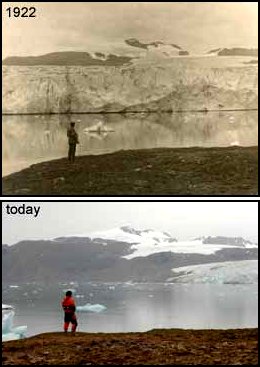
[Interviewing Jesse Jackson is] like boxing a glacier. Enjoy that metaphor, by the way, because your grandchildren will have no idea what a glacier is.
Record amounts of the Arctic ocean failed to freeze during the recent winter, new figures show, spelling disaster for wildlife and strengthening concerns that the region is locked into a destructive cycle of irreversible climate change.
Satellite measurements show the area covered by Arctic winter sea ice reached an all-time low in March, down some 300,000 square kilometres on last year -an area bigger than the UK.
Scientists say the decline highlights an alarming new trend, with recovery of the ice in winter no longer sufficient to compensate for increased melting in the summer. If the cycle continues, the Arctic ocean could lose all of its ice much earlier than expected, possibly by 2030.
Walt Meier, a researcher at the US National Snow and Ice Data Centre in Colorado, which collected the figures, said: "It's a pretty stark drop. In the winter the ice tends to be pretty stable, so the last three years, with this steady decline, really stick out."
Experts are worried because a long-term slow decline of ice around the north pole seems to have sharply accelerated since 2003, raising fears that the region may have passed one of the "tipping points" in global warming. In this scenario, warmer weather melts ice and drives temperatures higher because the dark water beneath absorbs more of the sun's radiation. This could make global warming quickly run out of control.
Dr Meier said there was "a good chance" the Arctic tipping point has been reached. "People have tried to think of ways we could get back to where we were. We keep going further and further into the hole, and it's getting harder and harder to get out of it."
The Arctic is rapidly becoming the clearest demonstration of the effects of mankind's impact on the global climate. The temperature is rising twice as fast as the rest of the planet and the region is expected to warm by a further 4C-7C by 2100. The summer and winter ice levels are the lowest since satellite monitoring began in 1979, and almost certainly the lowest since local people began keeping records around 1900. The pace of decline since 2003, if continued, would see the Arctic totally ice-free in summer within 30 years - though few scientists would stake their reputations on a long-term trend drawn from only three years.
Experts at the US Naval Postgraduate School in California think the situation could be even worse. They are about to publish the results of computer simulations that show the current rate of melting, combined with increased access for warmer Pacific water, could make the summertime Arctic ice-free within a decade. Dr Meier said: "For 800,000 to a million years, at least some of the Arctic has been covered by ice throughout the year. That's an indication that, if we are heading for an ice-free Arctic, it's a really dramatic change and something that is unprecedented almost within the entire record of human species."
The winter ice has declined all around the region - bad news for polar bears, which spend summer on land before returning to the ice in spring to catch food.

Scans early yesterday (Sydney time) confirmed Kewell had torn a groin muscle in the early stages of last weekend's FA Cup final...

Today is the last day to sign up for Medicare Part D, the prescription drug benefit. It appears that millions of Americans, confused by the array of competing plans or simply unaware of the cutoff date, will miss the deadline. This will leave them without drug coverage for the rest of the year, and subject to financial penalties for the rest of their lives.
[]
[P]rescription drug coverage didn't have to be bafflingly complex. Drug coverage could simply have been added to traditional Medicare. If the government had done that, everyone currently covered by Medicare would automatically have been enrolled in the drug benefit.
Adding drug coverage as part of ordinary Medicare would also have saved a lot of money, both by eliminating the cost of employing private insurance companies as middlemen and by allowing the government to negotiate lower drug prices. This would have made it possible to offer a better benefit at much less cost to taxpayers.
But while a straightforward addition of drug coverage to Medicare would have been good policy, it would have been bad politics from the point of view of conservatives, who want to privatize traditional social insurance programs, not make them better.
[]
So what we got was a drug program set up to serve the administration's friends and its political agenda, not the alleged beneficiaries. Instead of providing drug coverage directly, Part D is a complex system of subsidies to private insurance companies. The administration's insistence on running the program through these companies, which provide little if any additional value beyond what Medicare could easily have provided directly, is what makes the whole thing so complicated. And that complication, combined with an obvious lack of interest in making the system work, is what led to the disastrous start-up.
[]
And that's why when it comes to actual policy as opposed to politics, the Bush administration has turned out to have the reverse Midas touch. Everything it gets its hands on, from the reconstruction of Iraq to the rescue of New Orleans, from the drug benefit to the reform of the C.I.A., turns to crud.

WASHINGTON - President Bush has assured Americans that their government isn't spying on them, but history explains why many remain uneasy about this week's news that their phone records have been turned over to federal agents.
The government has a long track record of abusing personal information that's gathered in the name of national security. From the Red Scare in the 1920s to illegal wiretaps during the Nixon era, Americans have struggled to find the right balance between individual rights and collective security.
"The potential for abuse is awesome," a Senate investigation committee concluded in a 1976 report detailing illegal wiretaps, break-ins and other abuses that government agents committed in the 1960s and `70s.
The Senate panel, known as the "Church committee" after its chairman, Sen. Frank Church, D-Idaho, warned that technological advances would make it even harder for the government to stay within acceptable limits of respecting privacy rights, especially when the nation is at risk of attack.
[]
In some cases, intelligence-gatherers try to use the information they collect against their enemies. In one of the most notorious examples, FBI director J. Edgar Hoover launched a campaign to discredit King that included an attempt to get him to commit suicide.
After gathering evidence of King's extramarital affairs, the agency sent a compilation of incriminating audiotapes to King's wife and sent him a note suggesting that he take his own life.
"King, there is only one thing left for you to do. You know what it is. ... You are done. There is but one way out for you. You better take it before your filthy fraudulent self is bared to the nation," the note said.

Despite a congressional order that the military assess the mental health of all deploying troops, fewer than 1 in 300 service members see a mental health professional before shipping out.
Once at war, some unstable troops are kept on the front lines while on potent antidepressants and anti-anxiety drugs, with little or no counseling or medical monitoring.
And some troops who developed post-traumatic stress disorder after serving in Iraq are being sent back to the war zone, increasing the risk to their mental health.
These practices, which have received little public scrutiny and in some cases violate the military's own policies, have helped to fuel an increase in the suicide rate among troops serving in Iraq, which reached an all-time high in 2005 when 22 soldiers killed themselves - accounting for nearly one in five of all Army non-combat deaths.
The Courant's investigation found that at least 11 service members who committed suicide in Iraq in 2004 and 2005 were kept on duty despite exhibiting signs of significant psychological distress. In at least seven of the cases, superiors were aware of the problems, military investigative records and interviews with families indicate.
Among the troops who plunged through the gaps in the mental health system was Army Spec. Jeffrey Henthorn, a young father and third-generation soldier, whose death last year is still being mourned by his native Choctaw, Okla.
What his hometown does not know is that Henthorn, 25, had been sent back to Iraq for a second tour, even though his superiors knew he was unstable and had threatened suicide at least twice, according to Army investigative reports and interviews. When he finally succeeded in killing himself on Feb. 8, 2005, at Camp Anaconda in Balad, Iraq, an Army report says, the work of the M-16 rifle was so thorough that fragments of his skull pierced the barracks ceiling.

It's often those who make the accusations we should be most worried about. Mr. Goss, a particularly vivid example, should not escape into retirement unexamined. He was so inept that an overzealous witch hunter might mistake him for a Qaeda double agent.
Even before he went to the C.I.A., he was a drag on national security. In "Breakdown," a book about intelligence failures before the 9/11 attacks, the conservative journalist Bill Gertz delineates how Mr. Goss, then chairman of the House Intelligence Committee, played a major role in abdicating Congressional oversight of the C.I.A., trying to cover up its poor performance while terrorists plotted with impunity. After 9/11, his committee's "investigation" of what went wrong was notoriously toothless.
Once he ascended to the C.I.A. in 2004, Mr. Goss behaved like most other Bush appointees: he put politics ahead of the national interest, and stashed cronies and partisan hacks in crucial positions.
[]
It was under General Hayden, a self-styled electronic surveillance whiz, that the N.S.A. intercepted actual Qaeda messages on Sept. 10, 2001 — "Tomorrow is zero hour" for one — and failed to translate them until Sept. 12. That same fateful summer, General Hayden's N.S.A. also failed to recognize that "some of the terrorists had set up shop literally under its nose," as the national-security authority James Bamford wrote in The Washington Post in 2002. The Qaeda cell that hijacked American Flight 77 and plowed into the Pentagon was based in the same town, Laurel, Md., as the N.S.A., and "for months, the terrorists and the N.S.A. employees exercised in some of the same local health clubs and shopped in the same grocery stores."
If Democrats — and, for that matter, Republicans — let a president with a Nixonesque approval rating install yet another second-rate sycophant at yet another security agency, even one as diminished as the C.I.A., someone should charge those senators with treason, too.

Archeologists working high in the Peruvian Andes have discovered the oldest known celestial observatory in the Americas — a 4,200-year-old structure marking the summer and winter solstices that is as old as the stone pillars of Stonehenge.
The observatory was built on the top of a 33-foot-tall pyramid with precise alignments and sightlines that provide an astronomical calendar for agriculture, archeologist Robert Benfer of the University of Missouri said.
The people who built the observatory — three millenniums before the emergence of the Incas — are a mystery, but they achieved a level of art and science that archeologists say they did not know existed in the region until at least 800 years later.
Among the most impressive finds was a massive clay sculpture — an ancient version of the modern frowning "sad face" icon flanked by two animals. The disk, protected from looters beneath thousands of years of dirt and debris, marked the position of the winter solstice.
"It's really quite a shock to everyone … to see sculptures of that sophistication coming out of a building of that time period," said archeologist Richard L. Burger of Yale University's Peabody Museum of Natural History, who was not involved in the discovery.
The find adds strong evidence to support the recent idea that a sophisticated civilization developed in South America in the pre-ceramic era, before the development of fired pottery sometime after 1500 BC.
Benfer's discovery "pushes the envelope of civilization farther south and inland from the coast, and adds the important dimension of astronomy to these ancient folks' way of life," said archeologist Michael Moseley of the University of Florida, a noted Peru expert.

WASHINGTON, May 13 — In the weeks after the Sept. 11 attacks, Vice President Dick Cheney and his top legal adviser argued that the National Security Agency should intercept purely domestic telephone calls and e-mail messages without warrants in the hunt for terrorists, according to two senior intelligence officials.
But N.S.A. lawyers, trained in the agency's strict rules against domestic spying and reluctant to approve any eavesdropping without warrants, insisted that it should be limited to communications into and out of the country, said the officials, who were granted anonymity to discuss the debate inside the Bush administration late in 2001.
The N.S.A.'s position ultimately prevailed. But just how Gen. Michael V. Hayden, the director of the agency at the time, designed the program, persuaded wary N.S.A. officers to accept it and sold the White House on its limits is not yet clear.
It is extremely rare, if not unprecedented, for Cheney's own notes to be made public. The notes—apparently obtained as a result of a grand jury subpoena—would appear to make Cheney an even more central witness than had been previously thought in the criminal probe. Fitzgerald's prosecution has created continued problems for the White House. Karl Rove, the President Bush's chief political adviser, recently made his fifth grand jury appearance in the case and remains under scrutiny while Fitzgerald weighs whether to file criminal charges against him. For now, Libby is the only figure charged in the case.

Announcer:
And now, a message from the President of the United States.
President Al Gore:
Good evening, my fellow Americans.
In 2000 when you overwhelmingly made the decision to elect me as your 43rd president, I knew the road ahead would be difficult. We have accomplished so much yet challenges lie ahead.
In the last 6 years we have been able to stop global warming. No one could have predicted the negative results of this. Glaciers that once were melting are now on the attack.
As you know, these renegade glaciers have already captured parts of upper Michigan and northern Maine, but I assure you: we will not let the glaciers win.
Right now, in the 2nd week of May 2006, we are facing perhaps the worst gas crisis in history.
We have way too much gasoline. Gas is down to $0.19 a gallon and the oil companies are hurting.
I know that I am partly to blame by insisting that cars run on trash.
I am therefore proposing a federal bailout to our oil companies because - hey, if it were the other way around, you know the oil companies would help us.

The Hammers took an early two-goal lead thanks to Jamie Carragher's own goal and Dean Ashton's close-range strike, before Djibril Cisse pulled one back.
Steven Gerrard lashed home an equaliser after the break before Paul Konchesky's speculative cross put West Ham ahead.
Gerrard's stunning last-minute strike forced extra-time, with Pepe Reina saving from Bobby Zamora, Konchesky and Anton Ferdinand in the shoot-out.
Dietmar Hamann, Gerrard and John Arne Riise all scored from the spot for Liverpool, with only veteran Teddy Sheringham finding the net for West Ham.
Liverpool won a truly great FA Cup final played in a great spirit - but without one man West Ham would have had the trophy in their dressing room and would have been celebrating.
This was one of the classic Cup finals and it is desperately unfortunate that they should lose on penalties.
West Ham were the better side and should have won, but Liverpool had Steven Gerrard and that is why a very good season is now a great one for Rafael Benitez's side.
What a man, what a player and what a captain.
Liverpool made some good signings at the start of the season, but there was one man who was the best when they got him to sign a new contract and his name was Steven Gerrard.
Great players give you something extra when you are down and out and dead and buried and boy did Gerrard give Liverpool something extra.
Liverpool were a beaten side when the ball bounced out to him in the 90th minute of normal time, but it was a quite magnificent strike that beat Shaka Hislop and sent the game into extra time.
Gerrard is a man who doesn't know when he's beaten and he just scored an unbelieveable goal.
He looked like he was struggling with something, whether it was cramp or an injury, just before the ball came to him, and then he produced a strike like that with time running out.
It's what great players do and Gerrard is a great player.
[]
Liverpool claimed the trophy, but as I said, West Ham were the better side and can be proud of their efforts.
But once again, it was that man Gerrard who pulled Liverpool up when they were down and led them to the FA Cup.

Special Prosecutor Patrick Fitzgerald spent more than half a day Friday at the offices of Patton Boggs, the law firm representing Karl Rove.
During the course of that meeting, Fitzgerald served attorneys for former Deputy White House Chief of Staff Karl Rove with an indictment charging the embattled White House official with perjury and lying to investigators related to his role in the CIA leak case, and instructed one of the attorneys to tell Rove that he has 24 hours to get his affairs in order, high level sources with direct knowledge of the meeting said Saturday morning.
Robert Luskin, Rove's attorney, did not return a call for comment. Sources said Fitzgerald was in Washington, DC, Friday and met with Luskin for about 15 hours to go over the charges against Rove, which include perjury and lying to investigators about how and when Rove discovered that Valerie Plame Wilson was a covert CIA operative and whether he shared that information with reporters, sources with direct knowledge of the meeting said.


 Posts
All Comments


