Showing posts with label glaciers. Show all posts

Saturday, March 15, 2008

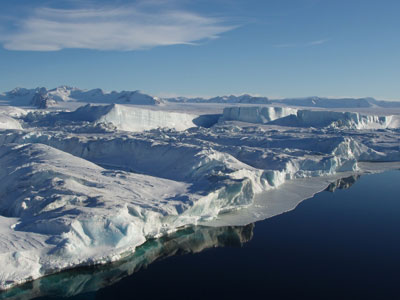
UN: Glaciers Melting At Fastest Rate in 5,000 Years

AP
UNEP warned that further ice loss could have dramatic consequences, particularly in India


Unfortunately, I can guarantee only one thing about this UN report: It will get a very tiny amount of coverage compared to Eliot Spitzer's having paid for sex.

Sunday Observer (uk): Glaciers melt 'at fastest rate in past 5,000 years'

The world's glaciers are melting faster than at any time since records began, threatening catastrophe for hundreds of millions of people and their eco-systems.

[]

Experts have been monitoring 30 glaciers around the world for nearly three decades and the most recent figures, for 2006, show the biggest ever 'net loss' of ice. Achim Steiner, head of the UN Environment Programme (UNEP), told The Observer that melting glaciers were now the 'loudest and clearest' warning signal of global warming.

The problem could lead to failing infrastructure, mass migration and even conflict. 'We're talking about something that happens in your and my lifespan. We're not talking about something hypothetical, we're talking about something dramatic in its consequences,' he said

Lester Brown, of the influential US-based Earth Policy Institute, said the problem would have global ramifications, as farmers in China and India struggled to irrigate their crops.

'This is the biggest predictable effect on food security in history as far as I know,' said Brown.

Sunday Observer (uk): Lost glaciers start countdown to climate chaos

[A]s they retreat, glacial lakes will burst, debris and ice will fall in avalanches, rivers will flood and then dry up, and sea levels will rise even further, say the climate experts. Communities will be deprived of essential water, crops will be ruined and power stations which rely on river flows paralysed.

As a result, people will have to change their lifestyles, their farming, even move their homes, says Achim Steiner, executive director of the United Nations Environment Programme (UNEP). He also fears the problem could exacerbate tensions over inadequate supplies between neighbouring states and countries, possibly spilling over into conflict.

'We're talking about a major transformation, from household livelihood to big industries,' says Steiner. 'While I'm always cautious about "water wars", certainly the potential for water to become a trigger for more tension and, where there's already conflict, to exacerbate conflict is another issue that's not hypothetical.'

The scale of the problem so alarms Lester Brown, a leading environmental thinker, that he fears huge populations dependent on glacier-fed rivers in Asia - 360 million on the Ganges in India and 388 million on the Yangtze in China alone - will not be able to feed themselves, with devastating effect on already rising global food prices.

Independent (uk): Glacier ice loss at record levels

Monday, January 14, 2008

Chilling News


Global warming is real. Are the politicians listening? At least the story is on page one of the Washington Post.

WaPo: Escalating Ice Loss Found in Antarctica
Sheets Melting in an Area Once Thought to Be Unaffected by Global Warming


Climatic changes appear to be destabilizing vast ice sheets of western Antarctica that had previously seemed relatively protected from global warming, researchers reported yesterday, raising the prospect of faster sea-level rise than current estimates.

While the overall loss is a tiny fraction of the miles-deep ice that covers much of Antarctica, scientists said the new finding is important because the continent holds about 90 percent of Earth's ice, and until now, large-scale ice loss there had been limited to the peninsula that juts out toward the tip of South America. In addition, researchers found that the rate of ice loss in the affected areas has accelerated over the past 10 years -- as it has on most glaciers and ice sheets around the world.

"Without doubt, Antarctica as a whole is now losing ice yearly, and each year it's losing more," said Eric Rignot, lead author of a paper published online in the journal Nature Geoscience.

The Antarctic ice sheet is shrinking despite land temperatures for the continent remaining essentially unchanged, except for the fast-warming peninsula.

The cause, Rignot said, may be changes in the flow of the warmer water of the Antarctic Circumpolar Current that circles much of the continent. Because of changed wind patterns and less-well-understood dynamics of the submerged current, its water is coming closer to land in some sectors and melting the edges of glaciers deep underwater.

"Something must be changing the ocean to trigger such changes," said Rignot, a senior scientist with NASA's Jet Propulsion Laboratory. "We believe it is related to global climate forcing."

Rignot said the tonnage of yearly ice loss in Antarctica is approaching that of Greenland, where ice sheets are known to be melting rapidly in some parts and where ancient glaciers have been in retreat. He said the change in Antarctica could become considerably more dramatic because the continent's western shelf, an expanse of ice and snow roughly the size of Texas, is largely below sea level and has broad and flat expanses of ice that could move quickly. Much of Greenland's ice flows through relatively narrow valleys in mountainous terrain, which slows its motion.

The new finding comes days after the head of the Intergovernmental Panel on Climate Change said the group's next report should look at the "frightening" possibility that ice sheets in Greenland and Antarctica could melt rapidly at the same time.


"Both Greenland and the West Antarctic ice sheet are huge bodies of ice and snow, which are sitting on land," said Rajendra Pachauri, chief of the IPCC, the United Nations' scientific advisory group. "If, through a process of melting, they collapse and are submerged in the sea, then we really are talking about sea-level rises of several meters." (A meter is about a yard.) Last year, the IPCC tentatively estimated that sea levels would rise by eight inches to two feet by the end of the century, assuming no melting in West Antarctica.

Monday, June 18, 2007

'The Earth todays stands in imminent peril'


Terrifying article. Is anyone in power listening?

The Independent (uk): The Earth today stands in imminent peril
and nothing short of a planetary rescue will save it from the environmental cataclysm of dangerous climate change. Those are not the words of eco-warriors but the considered opinion of a group of eminent scientists writing in a peer-reviewed scientific journal.


The unnatural "forcing" of the climate as a result of man-made emissions of carbon dioxide and other greenhouse gases threatens to generate a "flip" in the climate that could "spark a cataclysm" in the massive ice sheets of Antarctica and Greenland, the scientists write.

Dramatic flips in the climate have occurred in the past but none has happened since the development of complex human societies and civilisation, which are unlikely to survive the same sort of environmental changes if they occurred now.

"Civilisation developed, and constructed extensive infrastructure, during a period of unusual climate stability, the Holocene, now almost 12,000 years in duration. That period is about to end,"
the scientists warn. Humanity cannot afford to burn the Earth's remaining underground reserves of fossil fuel. "To do so would guarantee dramatic climate change, yielding a different planet from the one on which civilisation developed and for which extensive physical infrastructure has been built," they say.

Dr Hansen said we have about 10 years to put into effect the draconian measures needed to curb CO2 emissions quickly enough to avert a dangerous rise in global temperature. Otherwise, the extra heat could trigger the rapid melting of polar ice sheets, made far worse by the "albedo flip" - when the sunlight reflected by white ice is suddenly absorbed as ice melts to become the dark surface of open water.


The glaciers and ice sheets of Greenland in the northern hemisphere, and the western Antarctic ice sheet in the south, both show signs of the rapid changes predicted with rising temperatures."


Independent (uk): Climate change brings early spring in the Arctic


The Arctic spring is coming two weeks ahead of time compared to a decade ago, with birds, butterflies, flowers and small animals all appearing earlier in the year as a result of climate change.

A study of a range of animals and plants living in the high Arctic has revealed that many of them are responding to the earlier spring by flowering or laying their eggs significantly ahead of their normal times of the year.

On average, the breeding and flowering seasons in the Arctic have shifted by 14.5 days but some species of mosquitoes have begun laying their eggs 30 days earlier than in the mid 1990s
, Toke Hoye, of the University of Copenhagen in Denmark, said.

"Our study confirms what many people already think, that the seasons are changing and it is not just one or two warm years but a trend seen over a decade," Dr Hoye said. "This is the most extensive study of its kind in the Arctic in terms of the number and variety of species and the replication of the observations."