Showing posts with label New York City. Show all posts

Saturday, January 19, 2008

Good Reads


NYTimes: Pete Hamill Downtown, on Downtown

I just finished (I say "finished", not "read", because I listened to the book on tape) Pete Hamill's novel North River, set in New York City in 1934. It's a love story set within Pete Hamill's love of New York City and the people he grew up with. Recommended.

Tuesday, September 11, 2007

The Decider on 9/11/01

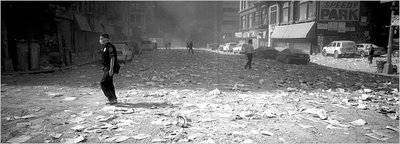
I'm too enraged about politics, Bush's War Without End, Amen and the dithering Democrats to write much these days. So here's my 9/11 post.

From Buzzflash:

A 9/11 Reminder from a 2004 BuzzFlash Editorial: "Minutes of Silence That Should Live in Infamy: As Americans Leapt to Their Deaths from the Twin Towers, George W. Bush Sat Cluelessly in a Florida Classroom, Endangering the Lives of the Children Around Him, Until His Handlers Could Figure Out What to Do With Him."


I wish I had written this, but I'm just too pissed off:

Lawyers, Guns and Money: Anniversary

Thursday, July 19, 2007

Memo to Manhattan: Dust Floats, and Asbestos Dust Floats Longer Than Other Dusts

A man wears a respirator over his face near the site of a steam pipe explosion in midtown Manhattan during the morning commute in New York July 19, 2007. REUTERS/Brendan McDermid

The government is lying to the people of New York City again. The steam pipe that exploded in midtown last night was insulated with asbestos, and asbestos was found in the debris in the area. New York City's Office of Emergency Management then announced that the air was safe to breathe.

That is complete and utter bullshit. I have represented people exposed to asbestos since 1983, and I know the following to be true:

(1) Dust floats.

(2) Asbestos dust floats longer than other dusts. Asbestos has unique aerodynamic properties. The mineral frays into tiny microscopic rectangles, and they float in the air like little balsa airplanes.

(3) THERE IS NO SAFE LEVEL OF EXPOSURE TO ASBESTOS. Asbestos is a carcinogen, and there is no safe level of exposure to a carcinogen.

Don't listen to the authorities. If you live or work in the affected area, you are breathing air which has asbestos particles in it. It may be a small amount, but it's there, and there's no safe level of exposure to a carcinogen. Limit your exposure. Keep your windows closed. Above all, don't listen to the government when they tell you there's no risk. That's false and misleading. There's a reason that the people working at the site are wearing respirators. There's asbestos in the air.

Incredibly, asbestos has not been banned in this country. It is still sold every day and more and more asbestos enters our environment. I support Senator Patty Murray's bill to ban asbestos.

Friday, July 13, 2007

Giuliani Called Off 9/11 Recovery Efforts After $230 Million in Gold Bullion Recovered

Here's the video the New York City Firefighters put out to debunk the urban legend of Rudy Giuliani, hero of 9/11. I knew he didn't get the firefighters working radios in the 9 years after the 1993 World Trade Center bombing and that's why so many -- 343 -- firefighters died, and I knew he put the emergency command center on the 23rd floor of the World Trade Center Bilding 7

But I didn't know that his controversial decision to end the recovery efforts for the bodies of the thousands killed there was made after the Bank of Nova Scotia's $230 in gold bullion was recovered. Then he started sending trucks of debris containing body parts to the Fresh Kills landfill in Staten Island. No wonder the firefighters hate him. Rudy is no hero.


Giuliani Bungled Preparation in Years After 1993 Attack on Trade Center.

Critical failures by former New York Mayor Rudy Giuliani before, during and after the terrorist attack on September 11, 2001, raise serious questions about his ability to be commander-in-chief.

In this thirteen minute documentary, fire fighters, fire officers and family members give dramatic testimony about Giuliani's leadership failures. Their dramatic stories tell how Giuliani failed to provide the FDNY with radios that worked, which led to the deaths of 121 fire fighters inside the World Trade Center's North Tower because they were unable to hear orders to evacuate.

Fire fighters also point to Giuliani's poor judgment in placing his emergency command center at 7 World Trade Center, a known terrorist target after the 1993 bombing.

This video documents the mayor's lack of respect for the fallen when he called off the recovery effort at Ground Zero on Nov. 1, 2001, after $200 million in gold bullion was recovered.

"We produced this documentary because we need to make sure our members know Giuliani's real record," said IAFF General President Harold Schaitberger.

"The UFA participated in this video to correct the myth that Rudy Giuliani has perpetrated on the American public," said Steve Cassidy, president of the Uniformed Firefighters Association of Greater New York, IAFF Local 94.

The Giuliani campaign defended the former mayor's record by issuing a release that lists items he purchased for FDNY.

"But the campaign, with its response, has neglected to address the charges of failed leadership outlined in our documentary," President Schaitberger said.

"Purchasing equipment for a fire department doesn't qualify any mayor to be president," said Jack McDonnell, president of New York City Local 854, the Uniformed Fire Officers Association.

"If that's the litmus test for president of the United States, then most mayors in this country qualify for the job. Giuliani is running on his 9/11 record, and his 9/11 record is laced with failures in preparedness and response," McDonnell said.

The IAFF has not made an endorsement in the 2008 presidential election. Local 94 supported President George W. Bush in the 2004 election, while the IAFF
and Local 854 endorsed Sen. John Kerry.

The International Association of Fire Fighters, headquartered in Washington, DC, represents more than 280,000 full-time professional fire fighters and paramedics in every state in the United States and in Canada. More information is available at www.iaff.org and at www.rudy-urbanlegend.com.

Friday, February 23, 2007

Another Reason I Wish I Was In New York Today

Wildlife Conservation Society

Biologists filmed José the beaver in the Bronx.


NYTimes: After 200 Years, a Beaver Is Back in New York City

A crudely fashioned lodge perched along the snow-covered banks of the Bronx River — no more than a mound of twigs and mud strewn together in the shadow of the Bronx Zoo — sits steps away from an empty parking lot and a busy intersection.

Scientists say that the discovery of this cone-shaped dwelling signifies something remarkable: For the first time in two centuries, the North American beaver, forced out of town by agricultural development and overeager fur traders, has returned to New York City.

The discovery of a beaver setting up camp in the Bronx is a testament to both the animal’s versatility and to an increasingly healthy Bronx River.

A few years ago the river was a dumping ground for abandoned cars and rubber tires, but it has been brought back to life recently through a big cleanup effort.

I Wish I Was In New York Today


So I could see this spectacle.

Telegraph (uk) Blog: I'm George Bush - please kick me

Beginning this afternoon in New York, the British performance artist Mark McGowan will crawl on his hands and knees for 72 hours dressed as George W Bush. He’ll be wearing a sign on his bottom that says: KICK MY ASS.

It’s obviously an extremely important cultural moment and I’m sure that museums and galleries will be lining up to install McGowan permanently somewhere in New York.

The artist will be on all-fours for 72 hours and will circumnavigate Manhattan covering 36 miles. He’ll wear knee pads and a cushion inside his trousers for protection.

Members of the public are encouraged to take part in the performance by actually kicking his posterior.

McGowan has said that he’s “offering the people of America, New York and visitors a service…a kind of therapeutic engagement. Hopefully people will be able to come and kick me (the President, George Bush) as hard as they like, and gain some comfort in the fact that they can say I kicked George in the ass. On a more serious note this is a protest against George Bush and his policies and I am expecting injuries, I just hope not too severe.”

Tuesday, February 20, 2007

Kirsten Gillibrand in NYTimes

Nathaniel Brooks for The New York Times

An Albany International Airport worker greeted his new congresswoman, Kirsten Gillibrand, with her mother, Polly Rutnik, and her son, Theo, 3.

Frenetic Start in Congress for One Democrat, Class of ’06

SARATOGA SPRINGS, N.Y. — When Kirsten Gillibrand was elected to Congress this past November in a tide of Democratic victories, she soon learned that her campaigning was not over.

This political novice found herself in a precarious position: a Democrat trying to represent an overwhelmingly Republican district extending into the state’s North Country, a onetime Manhattan lawyer in a place of factory and mill workers, dairy farmers and retired military veterans.

Now, even as the congratulatory letters continue to trickle in, she often looks like a candidate who is still on the run. Ms. Gillibrand, 40, spends virtually every free moment scurrying back from Washington to her district to attend town hall gatherings, meet-and-greets at local malls and — yes, already — a fund-raiser.

That frenetic pace reflects her uncomfortable reality: that her victory last fall, like the success of Democrats nationwide, may have been an aberration that could be undone with a swing in the mood of the electorate or by formidable opposition.

Politically, the first term is typically when House incumbents are most at risk of defeat. And Kirsten Gillibrand is among the most vulnerable of this group. Even her closest advisers acknowledged during last year’s campaign that her odds of winning were slim, given that she was facing a four-term Republican incumbent in a district where Republicans outnumbered Democrats by roughly 80,000.

Gillibrand was criticized in a recent post on firedoglake for her middle of the road positions and constant fundraising; I don't think people understand just how conservative and Republican her district is. Having grown up there, I do.

More from the NYTimes article on the district:

The passion the war arouses in her district was illustrated at that meeting. A constituent rushed up to her and loudly warned her not to support any of the resolutions that Democrats were considering to express disapproval of Mr. Bush’s proposed troop buildup in Iraq.

Pointing directly at Ms. Gillibrand, the man, Dave Browner, told her that many lives were at stake. “You’re in the big leagues now,” he said, his voice rising. “Any resolution will put our troops in danger.”

Then, as he turned and began storming off, Ms. Gillibrand did something that seemed to disarm him: she gently held him by the arm and thanked him for his thoughts. But ultimately, she did not commit to a position.

(As it turned out, on Feb. 16 she voted for a nonbinding resolution denouncing the president’s plan but including two simple clauses expressing support for the troops.)

Roots in the District

Such passions typify the 20th Congressional District, a bedrock Republican area that encompasses dairy farms, stretches of Adirondack State Park and the northern counties of exurban New York City, including Columbia and upper Dutchess, areas that have increasingly drawn New York commuters and second-home buyers.

I'm not sure if this is good news or not for Gillibrand (I no longer trust the Grey Lady after they withheld information about Bush Administration lawbreaking before the 2004 election, and then there's Judy Miller and the Clinton attacks of the 1990s) but the Times says this article is part of continuing series:

The Freshman
Settling In
This is the first article in a series that will chronicle Kirsten Gillibrand’s first year in Congress.

Monday, February 05, 2007

Vacation Book Report #6


A Gesture Life (1999) by Chang-rae Lee

**** out of five

I was a little unsure of this book given that all the endorsements on the back cover were for Lee's first book, Native Speaker (1995), although that is not surprising when I find that Native Speaker won the PEN/Hemingway Award, QPB's New Voices Award, the Barnes & Noble Discover Great New Writers Award, the Oregon Book Award, and the American Book Award.

A Gesture Life started slowly, introducing the main character, 'Doc' Hata, and his exemplary life in his bland surburban community on the outskirts of New York City. The book slowly opens up as Doc describes his distant past as a medic in the Japanese army during WWII (where he fell in love with a comfort girl), to his more recent difficulties with his adopted daughter Sunny. He is a great storyteller.

The prose is lovely, clean and lyrical, and I was not surprised to learn on the Penguin website that Lee is the director of the MFA program at Hunter College in New York City.

I look forward to reading Native Speaker.

Tuesday, January 30, 2007

Vacation Reading List


OK, I know I said I was going on hiatus, but you know what? I lied. I have a access to a computer and I am reading up a storm. So, here's the first book I read on my vacation:

Stuffed: Adventures of a Restaurant Family
(2001), by Patricia Volk

Rating: ***** (five stars out of five)

I love books about food and this is a great book about food and family. Volk's family ran a series of restaurants in New York City from 1888 to 1988, but this book is more about her amazing family. I loved it. I laughed and I cried. And I drove Coach Mom crazy by interrupting her book several times to read her the parts that made me laugh out loud.

A favorite passage:

Maybe you've heard of my Aunt Ruthie. She's the woman who was taken hostage in her Bronx apartment by an ex-paratrooper on August 4, 1990. It was a hot night. She left her bathroom window open. Jose Cruz climbed in and held Aunt Ruthie at gunpoint for seven hours. BRAVE, the Daily News ran under her photo on page 1. YIDDISH CHARM NAILS SUSPECT, said the New York Post. He ate all her plums, a wedge of Jarlsberg, and three nectarines before the police exchanged her for two cigarettes.

"When you go to prison," Aunt Ruthie counseled him, "Take out some books. Learn a different profession. It's important in life to get hold of yourself."

Sunday, December 03, 2006

What Do the Himalayas and the Catskills Have in Common?

Flooding, Sullivan County, New York, June 2006

Guardian (uk) (via RawStory):
Nepal's farmers on the front line of global climate change
Himalayan communities face catastrophic floods as weather patterns alter


Khetbari expects a small flood every decade or so, but what shocked the village was that the two largest have taken place in the last three years. According to Mr Tamang, a pattern is emerging. "The floods are coming more severely more frequently. Not only is the rainfall far heavier these days than anyone has ever experienced, it is also coming at different times of the year."

NYTimes, Nov. 28, 2005: Dam at a Catskill Reservoir Needs Emergency Repair, City Says (TimesSelect Wall)

The Schoharie Valley was hit with 100-year-floods in 1955, 1987 and again in 1996, when the Schoharie Reservoir reached its all-time high water level, more than six and a half feet over the top of the dam. A flood in April nearly matched that, and the area was hit with record rainfall in October.

''Seems like we've got 100-year floods coming every nine years now,'' said Fred Risse, a local farmer whose land lies in the flood plain of the Schoharie Creek. ''What happens when we get another?''

TimesHerald Record, June 30, 2006: Dealing with the aftermath

Along the Susquehanna in Binghamton and Wilkes-Barre, Pa., the deluge was severe. And here in northern Sullivan County the it was the worst anyone could recall. In fact, one early assessment suggested the Upper Delaware Valley had witnessed the kind of flooding thought to occur only two or three times a millennium.

"This was definitely a record flood," said Ward Freeman, assist director of the U.S. Geological Survey's Weather Science Center in Troy. "In the Delaware, the levels were the highest we've seen since we've been keeping track."

The agency has had gauges along the Delaware for 56 years.

At least one flood gauge posted at the mouth of the Callicoon Creek reported the Delaware had reached its 500-year flood stage.

Sunday, November 19, 2006

Flooded with Disinformation

Richard Perry/The New York Times

In June, a road was washed out in Roscoe, by the Beaverkill River in the Catskill region.


NYTimes: Our Towns
TimesSelect After 3 Floods, Trying to Brace for No. 4
(TimesSelect wall)

Here’s what’s at stake: The Delaware River is the longest nondammed river east of the Mississippi, extending 330 miles from the Catskills to the mouth of the Delaware Bay. Nearly 15 million people — about 5 percent of the nation’s population — rely on it and 216 tributaries for drinking water and industrial uses. New York City gets half of its water from three reservoirs on the Delaware, and countless towns from here to the Atlantic exist because the river does.

From 1955 to 1996, there were no major floods. Now, it seems, there’s one every year. The Delaware River Basin Commission, which manages the river system, has begun a flood mitigation study, but on Thursday you could hear the frustration in the voice of every resident who spoke.

“I hear the word rain, and I hear a four-letter word,” said Joan Homovich, a retired teacher, who estimates her basement has flooded 10 times since 2003 and now obsessively goes online studying water releases from the reservoirs on the river. “When I thought about this rain I couldn’t eat.”

Part of the difficulty is a blizzard of conflicting agendas.

New York City, which controls the reservoirs, wants to be assured of drinking water for more than eight million people. Upstate residents want the city to also use the reservoirs to manage river flows and minimize flooding. Fishermen and environmentalists want to protect fisheries and limit man-made disruptions on the river. Towns want to be able to dredge and clean out streams to improve water flows that would prevent flooding.

[]

Residents want the agency to release water and lower the reservoir levels, creating a void that could trap rainfall that could otherwise cause flooding. The agency says its options are limited because the reservoirs are not built for flood control. But for the first time it has said it would make efforts in that direction.

Residents say the city is already failing to deliver. (The agency says reservoirs are now at 100.5 percent of capacity. Normal is 70 percent.)

[]

This year in the Catskills is among the wettest on record, but who knows what to read into a few years of wet weather. Freak of nature? Global warming? Thirty-year rainfall cycle? Act of God?

No one knows, and there are acts of nature that are beyond the machinations of man.

But despite the weaselly words with which the NYTimes ends its piece on the floods in the Catskills, these types of floods are predicted by the science of climate change. I heard Al Gore describe this type of weather scenario in An Inconvenient Truth.

Al Gore, transcript (unofficial), An Inconvenient Truth

What is often unnoticed the fact that global warming causes more precipitation but more of it coming in one time big storm events because the evaporation off the ocean puts all the moisture up there when storm conditions trigger the downpour before it falls down.

[]

The places where people live were chosen because of the climate pattern that had been pretty much the same on Earth since the end of the last ice age. Here on [my] farm, patterns are changing. It seems gradual in the course of a human lifetime but in the course of time as defined by this river, it's happening very, very quickly.

Saturday, October 07, 2006

Maybe Someday We'll Be Able to Stop Taking Off Our Shoes at Airport Security, Too

Patrick Andrade for The New York Times

Barriers at Seventh Avenue and 42nd Street have been removed, leaving imprints on the concrete.

NYTimes: Security Barriers of New York Are Removed

They started appearing on Manhattan streets immediately after September 11: concrete and metal barriers in front of skyscrapers, offices and museums. Some were clunky planters; others were shaped artfully into globes. They were meant to be security barriers against possible car or truck bombers in a jittery city intent on safeguarding itself.

But now, five years later, their numbers have begun to dwindle. After evaluations by the New York Police Department, the city’s Department of Transportation has demanded that many of the planters and concrete traffic medians known as jersey barriers be taken away. So far, barriers have been removed at 30 buildings out of an estimated 50 to 70 in the city.

Officials found that the barriers obstructed pedestrian flow — and, in the case of planters, often ended up being used as giant ashtrays. Counterterrorism experts also concluded that in terms of safety, some of the barriers, which building owners put in of their own accord, might do more harm than good.

Sunday, September 24, 2006

My Hometown Hits The Front Page of the New York Times

James Estrin/The New York Times
In the Town of Colchester, in the Catskills, court is in the garage.


Broken Bench
In Tiny Courts of New York, Abuses of Law and Power


Some of the courtrooms are not even courtrooms: tiny offices or basement rooms without a judge’s bench or jury box. Sometimes the public is not admitted, witnesses are not sworn to tell the truth, and there is no word-for-word record of the proceedings.

A yearlong investigation by The New York Times of the life and history of New York State’s town and village courts found a long trail of judicial abuses and errors — and of governmental failure to curb them.

Nearly three-quarters of the judges are not lawyers, and many — truck drivers, sewer workers or laborers — have scant grasp of the most basic legal principles. Some never got through high school, and at least one went no further than grade school.

But serious things happen in these little rooms all over New York State. People have been sent to jail without a guilty plea or a trial, or tossed from their homes without a proper proceeding. In violation of the law, defendants have been refused lawyers, or sentenced to weeks in jail because they cannot pay a fine. Frightened women have been denied protection from abuse.

These are New York’s town and village courts, or justice courts, as the 1,250 of them are widely known. In the public imagination, they are quaint holdovers from a bygone era, handling nothing weightier than traffic tickets and small claims. They get a roll of the eyes from lawyers who amuse one another with tales of incompetent small-town justices.


In the 8-page article itself, there is no mention of the Town of Colchester. The audio slide show in the left column repeats this photo, but again no detail about Colchester. I wonder if we will be featured in Parts II or III of the series? Stay tuned.

UPDATE: I am informed by a reliable source (thanks Coach Mom) that the court pictured is in Cooks Falls, one of the hamlets located within the Town of Colchester. That tiny court hears traffic tickets. There is another, larger court facility where Town Justice Theodore Fonda, a former New York City police officer, hears cases.

Thursday, September 21, 2006

First Round: Anucha Browne Sanders 1, Knicks/Isiah Thomas 0


The EEOC, the federal administrative agency that enforces employment law, has found "probable cause" to believe Anucha Browne Sanders was sexually harassed by Isiah Thomas, and that the New York Knicks retaliated against her by firing her when she complained.

Under Title VII, the federal employment law, and under New York State law, a plaintiff is required to present her claims at the agency level first prior to going to court. Because of the very short time limits to file employment cases, her case is also filed in federal court, and according to these articles settlement discussions have been initiated there.

The probable cause finding by the EEOC is admissible in court, but that doesn't mean that the case is over, or that Sanders will necessarily win at trial. At trial it is just another piece of evidence in her favor.

This is the result I expected, as Browne Sanders is a respected professional with years of accomplishments on her resume, and she has one of the best plaintiff's employment law firms in New York City representing her. They wouldn't have taken her claim if it wasn't a winner. However, the EEOC doesn't always get it right; the agency has been under attack from within for years, as the Bush Administration has choked off funds and prefers the agency to bring cases for whites claiming reverse discrimination. So it is a victory for her to get this ruling.

It will be interesting to see if the Knicks continue to take this hard stand, or if they face reality and put some real money on the table. They can take this to trial, but they'll lose. Isiah Thomas hasn't had a winner since he left the court for the Detroit Pistons. He destroyed the CBA, tried to destroy the Indiana Pacers (he was interrupted from the mission when GM Larry Bird fired his ass), and is in the process of destroying the New York Knicks. You've got to have a big ego to fire Larry Brown.

NYTimes: [EEOC] Report Supports Claims in Suit Against Thomas

The commission’s investigation supported Browne Sanders’s contention that she had been a victim of more than one incident of harassment and that “she was subjected to a hostile work environment including, but not limited to, severe and pervasive verbal sexual harassment.”

The determination, by Spencer H. Lewis Jr., the district director of the [Equal Employment Opportunity Commission]’s New York office, said the Garden had failed to take “reasonable care to prevent or correct discrimination and harassment in the workplace.”

Lewis made his determination last Friday, and it was released yesterday. His two-page letter did not describe the scope of the commission’s investigation or name witnesses.

Lewis found that the commission’s inquiry supported Browne Sanders’s contention that the Garden had fired her in retaliation for reporting her claims to her supervisors. Lewis also wrote that there was probable cause to believe the Garden violated Title VII of the Civil Rights Act of 1964. The Garden, but not Thomas, was the subject named in the commission’s investigation.


NYDaily News: Ruling supports accuser's suit

Newsday: Point for MSG accuser
Agency affirms executive's claim she was harassed, fired for complaining and clears way for settlement talks


SI: Mess at MSG
EEOC: Evidence supports Knicks exec's claims

Saturday, August 26, 2006

Tee Hee


I received this in email:

An old Arab lives close to New York City.

He would love to plant potatoes in his garden, but he is old and weak. His son is in college in Paris, so the old man sends him an e- mail.

"Beloved son, I am very sad, because I can't plant potatoes in my garden. I am sure if you were here you would help me dig up the garden."

The following day, the old man receives a response e-mail from his son at 3:45 pm: "Beloved father, please don't touch the garden. It's there that I have hidden 'the THING'. Love, Ahmed".

At 4:02 pm, the US Army, the Marines, the Rangers, the local police, officers from the Department of Homeland Security, the FBI and the CIA, visit the house of the old man, take the whole garden apart, search every inch, but can't find anything. Disappointed, they leave.

A day later, the old man receives another e-mail from his son: "Beloved father, I hope the garden is dug up by now and you can plant your potatoes. That's all I could do for you from here. Love, Ahmed.

Tuesday, June 06, 2006

OSHA, EPA & City Failed New Yorkers Cleaning Up Ground Zero


I missed this story on Sunday. The New York Times published a long article on the reason why so many Ground Zero cleanup workers now have lung disease. They didn't use respirators.

One thing that neither the Times article nor the excellent analysis by Confined Space point out is that respirators are safety issues themselves. They make it difficult for workers to communicate with each other. Therefore, employers must be especially vigilant when requiring their use, because workers aren't going to want to use anything that makes it harder to yell "Watch out!" and be heard. The worker recognizes the immediate safety threat of the difficulty in communicating; they don't necessarily assign the long-term threat of lung disease the same priority. Employers care far about the cost of the job than anything else. That's why government agencies, who are aware of the health threat, must be involved in requiring these safety devices. At Ground Zero, the government failed utterly, starting with Christy Todd Whitman, head of EPA, who declared the air around Ground Zero safe to breathe when it was, in actuality, toxic.

Anthony DePalma, NYTimes: Air Masks at Issue in Claims of 9/11 Illnesses

With mounting evidence that exposure to the toxic smoke and ash at ground zero during the nine-month cleanup has made many people sick, attention is now focusing on the role of air-filtering masks, or respirators, that cost less than $50 and could have shielded workers from some of the toxins.

More than 150,000 such masks were distributed and only 40,000 people worked on the pile, but most workers either did not have the masks or did not use them.

[]

From legal documents presented in the case, a tale emerges of heroic but ineffective efforts to protect workers, with botched opportunities, confused policies and contradictions that failed to ensure their safety.

Lawyers representing the workers say that there was no central distribution point for the respirators, no single organization responsible for giving them out, and no one with the power to make sure the respirators that were distributed got used, and used properly.

By contrast, at the Pentagon, workers not wearing proper protective gear were escorted off the site.


Confined Space: World Trade Center Recovery: Dereliction of Duty

The problem began with a statement by then EPA administrator Christie Todd Whitman assuring lower Manhattan workers and residents that the air was safe to breathe. DePalma reports that "the agency's inspector general concluded in 2003 that Ms. Whitman's statement was far too broad and could not be scientifically supported at the time she made it."

Personally, I think DePalma's being a bit too nice. The IG actually found that White House officials instructed the agency to be less alarming and more reassuring to the public in the first few days after the attack than EPA officials originally wanted to be. And earlier this year, Judge Deborah A. Batts of Federal District Court found that Whitman had deliberately mislead the public when she reassured the public after the collapse of the World Trade Centers that the air was safe to breathe in lower Manhattan and Brooklyn. The result of Whitman's lack of concern were devastating for recovery workers, according to Dave Newman of the New York Committee on Occupational Safety and Health who argues that after Whitman's statement, employers "had a green light to say, 'We don't need to use respirators because the E.P.A. says the air is OK.' "

[]

But the real culprit here is the Occupational Safety and Health Administration, the agency tasked by Congress to ensure the health and safety of American workers. And you can look long and hard at the Occupational Safety and Health Act without finding any exception for federally declared disasters:

As the magnitude of the recovery operation grew clearer, attempts were made to bring order to the operation. On Sept. 20 the city issued its first safety plan, and it asked the Occupational Safety and Health Administration to take charge of distributing respirators. In what would become a controversial move, OSHA used its discretionary powers to decide not to enforce workplace safety regulations but to act in a supportive role that would not slow down operations.


Previous posts:

9/11 EPA Victims
(May 16, 2006)

First Death Officially Linked to 9/11 Clean-Up
(April 12, 2006)

Have a Nice Day, Christy Todd Whitman (April 12, 2006)

Liars (April 9, 2006)

Too Bad This Isn't a Criminal Case. Christy Todd Whitman Should Be in Jail.
(February 2, 2006)

Republicans to FDNY: Drop Dead
(November 15, 2005)

Environmental Protection Agency Also Run By "Inept Political Hacks"
(September 11, 2005)

Christy Todd Spineless (March 23, 2005)

Thursday, June 01, 2006

Did You Laugh On 9/11? Bush Did.


Peter Daou, Huffington Post: Bush Jaw-Dropper: 9/11/01 "Ended on a Relatively Humorous Note"

[]...Democratic Underground has dug up a jaw-dropping 2003 Ladies' Home Journal interview with the Bushes. Having been in Manhattan on that day and watched two limbs of my home city get amputated, I find the following excerpt astounding:

"[Peggy] Noonan: You were separated on September 11th. What was it like when you saw each other again?

Mrs. Bush: Well, we just hugged. I think there was a certain amount of security in being with each other than being apart.

President Bush: But the day ended on a relatively humorous note. The agents said, "You'll be sleeping downstairs. Washington's still a dangerous place." And I said no, I can't sleep down there, the bed didn't look comfortable. I was really tired, Laura was tired, we like our own bed. We like our own routine. You know, kind of a nester. Like the way things are. I knew I had to deal with the issue the next day and provide strength and comfort to the country, and so I needed rest in order to be mentally prepared. So I told the agent we're going upstairs, and he reluctantly said okay. Laura wears contacts, and she was sound asleep. Barney was there. And the agent comes running up and says, "We're under attack. We need you downstairs," and so there we go. I'm in my running shorts and my T-shirt, and I'm barefooted. Got the dog in one hand, Laura had a cat, I'm holding Laura --

Mrs. Bush: I don't have my contacts in, and I'm in my fuzzy house slippers --

President Bush: And this guy's out of breath, and we're heading straight down to the basement because there's an incoming unidentified airplane, which is coming toward the White House. Then the guy says it's a friendly airplane. And we hustle all the way back upstairs and go to bed.

Mrs. Bush: [laughs] And we just lay there thinking about the way we must have looked.

Noonan: So the day starts in tragedy and ends in Marx Brothers.

President Bush: That's right -- we got a laugh out of it." [Emphasis added]

I don't even remember smiling on 9/11.

And then we get today's news, that the Department of Uber Alles, I mean Homeland Security, has cut terrorism funding for New York City by 40%, in part relying on a DHS form which says that New York City has no national monuments or icons worth protecting. They're the Marx Brothers, all right -- the most incompetent boobs ever to run this country.

Why I Will Never Vote for John Kerry for National Office Again


He didn't stay and fight for every vote, like he promised. The Robert F. Kennedy article in tomorrow's Rolling Stone on the theft of the 2004 election is too little, too late. We are stuck with the class clown at the helm for another two and one-half years. God help us.

I'm supporting John Bonifaz for Secretary of State in Massachusetts, because when he heard that Kerry lost Ohio, while Kerry took his $15 million war chest and went home, Bonifaz bought a plane ticket to Columbus and fought to have the votes counted.

No more Vichy Democrats. You can't win if you don't fight.


Robert F. Kennedy, Rolling Stone: Was the 2004 Election Stolen?


Like many Americans, I spent the evening of the 2004 election watching the returns on television and wondering how the exit polls, which predicted an overwhelming victory for John Kerry, had gotten it so wrong. By midnight, the official tallies showed a decisive lead for George Bush -- and the next day, lacking enough legal evidence to contest the results, Kerry conceded. Republicans derided anyone who expressed doubts about Bush's victory as nut cases in ''tinfoil hats,'' while the national media, with few exceptions, did little to question the validity of the election. The Washington Post immediately dismissed allegations of fraud as ''conspiracy theories,''(1) and The New York Times declared that ''there is no evidence of vote theft or errors on a large scale.''(2)

But despite the media blackout, indications continued to emerge that something deeply troubling had taken place in 2004. Nearly half of the 6 million American voters living abroad(3) never received their ballots -- or received them too late to vote(4) -- after the Pentagon unaccountably shut down a state-of-the-art Web site used to file overseas registrations.(5) A consulting firm called Sproul & Associates, which was hired by the Republican National Committee to register voters in six battleground states,(6) was discovered shredding Democratic registrations.(7) In New Mexico, which was decided by 5,988 votes,(8) malfunctioning machines mysteriously failed to properly register a presidential vote on more than 20,000 ballots.(9) Nationwide, according to the federal commission charged with implementing election reforms, as many as 1 million ballots were spoiled by faulty voting equipment -- roughly one for every 100 cast.(10)

The reports were especially disturbing in Ohio, the critical battleground state that clinched Bush's victory in the electoral college. Officials there purged tens of thousands of eligible voters from the rolls, neglected to process registration cards generated by Democratic voter drives, shortchanged Democratic precincts when they allocated voting machines and illegally derailed a recount that could have given Kerry the presidency. A precinct in an evangelical church in Miami County recorded an impossibly high turnout of ninety-eight percent, while a polling place in inner-city Cleveland recorded an equally impossible turnout of only seven percent. In Warren County, GOP election officials even invented a nonexistent terrorist threat to bar the media from monitoring the official vote count.(11)

Any election, of course, will have anomalies. America's voting system is a messy patchwork of polling rules run mostly by county and city officials. ''We didn't have one election for president in 2004,'' says Robert Pastor, who directs the Center for Democracy and Election Management at American University. ''We didn't have fifty elections. We actually had 13,000 elections run by 13,000 independent, quasi-sovereign counties and municipalities.''

But what is most anomalous about the irregularities in 2004 was their decidedly partisan bent: Almost without exception they hurt John Kerry and benefited George Bush. After carefully examining the evidence, I've become convinced that the president's party mounted a massive, coordinated campaign to subvert the will of the people in 2004. Across the country, Republican election officials and party stalwarts employed a wide range of illegal and unethical tactics to fix the election. A review of the available data reveals that in Ohio alone, at least 357,000 voters, the overwhelming majority of them Democratic, were prevented from casting ballots or did not have their votes counted in 2004(12) -- more than enough to shift the results of an election decided by 118,601 votes.(13) (See Ohio's Missing Votes) In what may be the single most astounding fact from the election, one in every four Ohio citizens who registered to vote in 2004 showed up at the polls only to discover that they were not listed on the rolls, thanks to GOP efforts to stem the unprecedented flood of Democrats eager to cast ballots.(14) And that doesn?t even take into account the troubling evidence of outright fraud, which indicates that upwards of 80,000 votes for Kerry were counted instead for Bush. That alone is a swing of more than 160,000 votes -- enough to have put John Kerry in the White House.(15)

Friday, May 26, 2006

Is The Media Ready to Cover Politics Substantively?


Paul Krugman asks, will America get fooled again? When he says 'we', he means the public and the press. I say, the public voted for Gore in 2000, despite the relentless drubbing he took in the corporate press, including the New York Times. This article really should be aimed squarely for the media. Will the media cover the issues? Or is PR and image everything? Will the media once again cover Karl Rove photo ops as substance, when they are merely showtime?

Paul Krugman, NYTimes: A Test of Our Character (TimesSelect wall)

the concluding grafs:

Why, after all, was Mr. Gore's popular-vote margin in the 2000 election narrow enough that he could be denied the White House? Any account that neglects the determination of some journalists to make him a figure of ridicule misses a key part of the story. Why were those journalists so determined to jeer Mr. Gore? Because of the very qualities that allowed him to realize the importance of global warming, many years before any other major political figure: his earnestness, and his genuine interest in facts, numbers and serious analysis.

And so the 2000 campaign ended up being about the candidates' clothing, their mannerisms, anything but the issues, on which Mr. Gore had a clear advantage (and about which his opponent was clearly both ill informed and dishonest).

I won't join the sudden surge of speculation about whether "An Inconvenient Truth" will make Mr. Gore a presidential contender. But the film does make a powerful case that Mr. Gore is the sort of person who ought to be running the country.

Since 2000, we've seen what happens when people who aren't interested in the facts, who believe what they want to believe, sit in the White House. Osama bin Laden is still at large, Iraq is a mess, New Orleans is a wreck. And, of course, we've done nothing about global warming.

But can the sort of person who would act on global warming get elected? Are we — by which I mean both the public and the press — ready for political leaders who don't pander, who are willing to talk about complicated issues and call for responsible policies? That's a test of national character. I wonder whether we'll pass.

The full article, from Ed Strong.

Monday, May 22, 2006

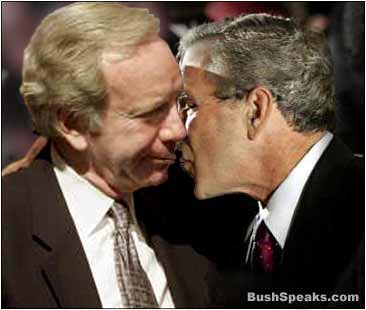
Joe Lieberman Is Out Of Touch With Reality

Hey Joe, don't feel bad, nobody likes this guy, either.


So saith Paul Krugman in today's New York Times. And since the Democrats are the party of the reality-based community, he has to go. I'll wager that Connecticut is firmly in the reality-based community too, so much so that even if Joe keeps to his threat and runs as an independent, he'll get handed his hat. Vichy Democrats need not apply. Feel the Nedrenaline!

Paul Krugman, NYTimes: Talk-Show Joe (Walled)

Friday was a bad day for Senator Joseph Lieberman. The Connecticut Democratic Party's nominating convention endorsed him, but that was a given for an incumbent with a lot of political chips to cash in. The real news was that Ned Lamont, an almost unknown challenger, received a third of the votes. This gave Mr. Lamont the right to run against Mr. Lieberman in a primary, and suggests that Mr. Lamont may even win.

What happened to Mr. Lieberman? Some news reports may lead you to believe that he is in trouble solely because of his support for the Iraq war. But there's much more to it than that. Mr. Lieberman has consistently supported Republican talking points. This has made him a lion of the Sunday talk shows, but has put him out of touch with his constituents — and with reality.

Mr. Lieberman isn't the only nationally known Democrat who still supports the Iraq war. But he isn't just an unrepentant hawk, he has joined the Bush administration by insisting on an upbeat picture of the situation in Iraq that is increasingly delusional.

Read it all at Ed Strong.